
Panola County 72-Hour Release Finding
Panola County does not publish a verified 72-hour or three-day release view. The sheriff-linked portal is expressly for current inmates. When reviewed on August 2, 2026, its public records were unreleased rows and provided no release-date value. Relabeling that roster as a release list would misstate both its scope and its fields.
The county still keeps records of custody movements. A requester can define an exact 72-hour interval and ask for the transactions that fall within it. The combined county portal can also connect jail, jail-bond, and criminal-cause information. Together, those sources are more durable than a changing roster snapshot.
Audit Panola County Three-Day Releases
Set the window before searching. Write the starting timestamp, ending timestamp, and time zone in the request. This avoids a rolling “last three days” phrase that changes while staff process it. Use identifiers tied to the booking and preserve the source's “as of” time.
- Check the Panola current-inmate portal to identify people shown in custody now. Do not treat absence as a release result.
- Open the Panola court and jail portal. Search Jail Records, Jail Bond Records, and the criminal case for entries within the same period.
- Call the Detention Center at 903-693-0359 about one person and booking when a prompt status check is needed. Ask for the written transaction when the exact event matters.
- Submit the county public-information form, choose the jail or sheriff records category, and request all responsive release transactions in the fixed interval.
- Reconcile each transaction with its legal authority and destination. Search another county, TDCJ, BOP, or ICE only when the record points there.
The narrower Panola County 24-Hour Releases method is preferable for a same-day check. It reduces the volume and may help staff locate a recent transaction faster.
Panola 72-Hour Release Record Fields
A proper three-day response should preserve the event fields, not merely a list of names. Ask for existing records rather than asking staff to reconstruct a narrative. A code legend is useful when the system records a short disposition code.
| Requested field | Why it belongs in the three-day review |
|---|---|
| Name plus booking or SO number | Separates namesakes and repeat admissions. |
| Booking time | Connects the departure to the correct custody period. |
| Actual release date and time | Places the event inside or outside the exact 72-hour boundary. |
| Release disposition or code | Identifies bond, order, sentence completion, transfer, or another event. |
| Releasing authority | Connects the transaction with the court, bond, or agency action. |
| Destination or receiving agency | Distinguishes community release from continued confinement. |
| Charge, cause, and bond fields | Allows comparison with the matching jail-bond and court record. |
Requesting a booking photograph is optional and should be tied to the exact booking. It cannot substitute for the release transaction. Sensitive details that do not help verify identity or custody need not be reproduced.
Panola Releases Across Weekends
A three-day span can bridge days when web updates or office responses are less predictable. It can also capture a Friday event discovered on Monday. No official Panola source, however, states a special weekend or holiday release schedule. The wider interval is a records technique, not evidence that the jail releases people at a set time.
Different records can carry different moments. A bond may post before staff complete hold, identity, property, and transportation checks. A judge may sign an order before physical departure. A transfer may appear in Panola's system before the receiving authority completes intake. Build a timeline rather than forcing those times to match.
Note: Use explicit dates and times because “72 hours” keeps moving while a request is pending.
Panola Current Portal Data Quirks
Panola launched the current-inmate portal in June 2026. The county says it displays mug shots, charges, and arresting agency. Research also observed names, SO numbers, booking and arrest dates, bond details, physical descriptors, and photos. The live interface did not expose a historical release window.
Open the officially linked current portal shown below to check the system's present view.
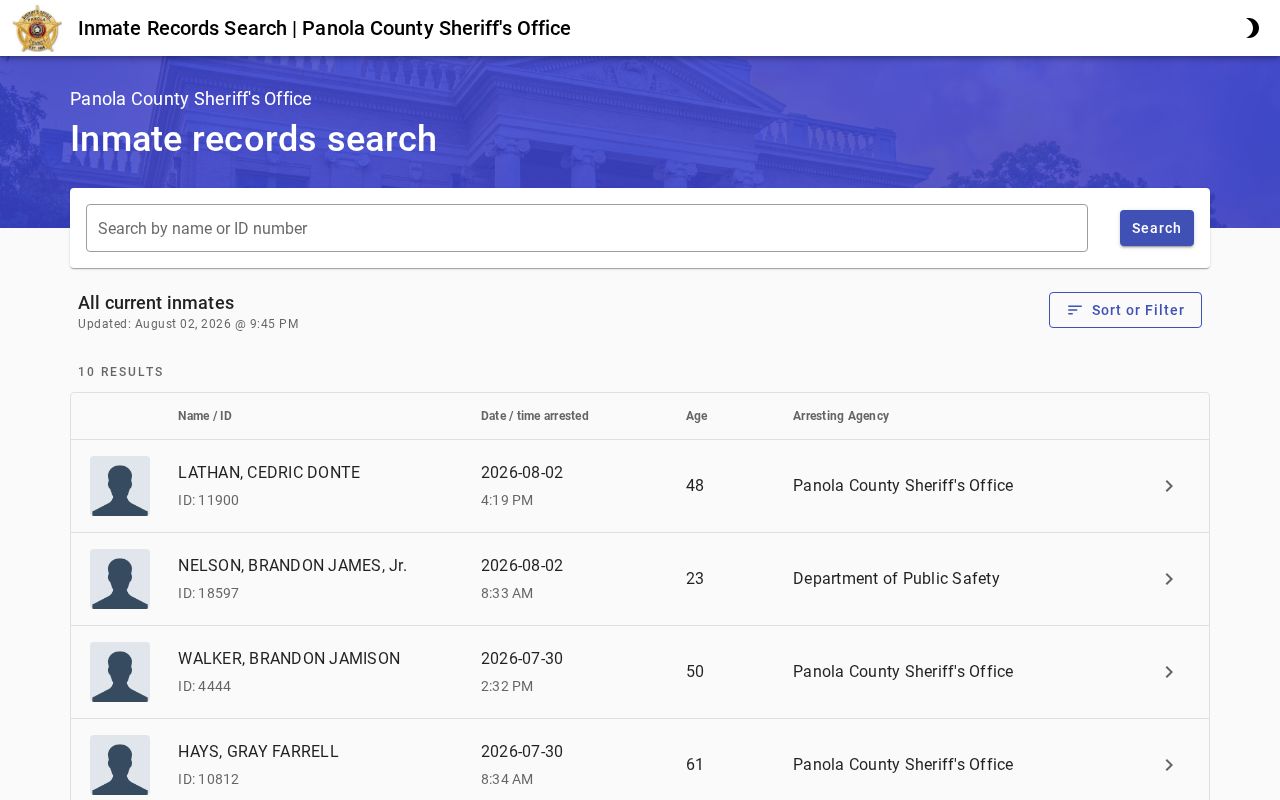
This screen is the start of the comparison, not the result. A missing row must be followed through the jail or bond archive and the custodian's transaction.
Why Panola Roster Rows Disappear
Community release is only one explanation. Panola custody can end through a transfer to TDCJ, another county, BOP or USMS custody, or immigration authorities. Vendor corrections, duplicate resolution, protected-record handling, and other administrative changes can alter the view. A death or escape may also end current roster treatment without being a community release.
- Bond
- Authority for release on a charge, not final disposition of that case.
- Time served
- Sentence credit or completion reflected in a judgment or order.
- Transfer
- Departure from Panola while another custodian continues confinement.
- Parole
- Supervised TDCJ release, not sentence discharge.
- Discharge
- Completion of a sentence or custodial term, subject to other unrelated authority.
Panola's portal included outside agency labels during research. An arresting or holding agency name does not by itself establish the receiving destination. Ask for the destination entry and then seek corroborating intake from that agency.
Verify Panola Three-Day Release Events
The strongest proof is a custodian-generated transaction with identity, booking, actual departure time, reason, releasing authority, and destination. The next layer is the legal authority, such as a signed bond, order, judgment, commitment, or dismissal. It explains why release could occur, but another hold may delay or prevent departure.
Notifications are useful corroboration. Texas VINELink can report a participating source's custody event. TDCJ IVSS addresses state custody and supervision, while BOP and ICE maintain separate federal locators. A Panola release alert can still refer to a transfer, so capture the agency, wording, and alert time before confirming the destination.
| Source | What it can establish | Main limit |
|---|---|---|
| Panola release transaction | Actual county departure and destination | Must match the right booking |
| Court or bond record | Legal authority or case action | May predate physical departure |
| Receiving system | Continued custody after transfer | Intake can lag |
| VINELink notice | Timely reported status change | Not a certified historical ledger |
Panola Release Versus State Transfer
A county detainee and a state prisoner require different searches. When Panola records a transfer to TDCJ, use the state current-prisoner search after intake. Its public data is refreshed on working days and is at least 24 hours old. If the person has already left TDCJ, request incarceration history because released people are omitted from the public web search.
Parole and mandatory supervision mean the person left prison under supervision. They are not unconditional discharge. Federal release also may lead to supervised release, another custodian, or immigration custody. “Not in BOP Custody” does not prove presence in Panola County or freedom in the community.
The Panola County released-inmate search connects these named-person channels. For a three-day list, keep the focus on county transactions whose actual departure times fall within the stated window.
Resolve Panola Release Date Conflicts
Conflicts are common when a 72-hour review crosses multiple systems. List the court authorization, bond posting, county departure, receiving intake, notification, and supervision record in time order. Mark date-only entries as date-only. Do not silently turn a projected, authorized, or reported date into an actual jail release timestamp.
If one field remains unclear, ask the office that created it. The Panola public-information form accepts a detailed description and a written response route, with email preferred. A focused follow-up can ask for the code definition, correction record, or receiving acknowledgement tied to the same booking.
The result should state what Panola's custodian recorded and what the destination source later confirmed. That keeps a three-day review useful even when feeds update at different speeds.
Frame Panola 72-Hour Record Requests
The county form offers Jail Records and Sheriff's Office Records as request categories. Give enough detail to locate existing material: the full interval, person's name when the request concerns one event, booking or SO number if known, and the desired written response channel. Email is identified as the preferred route. Do not ask staff to decide who “got out.” Ask for the transactions whose actual release timestamps fall within the dates and times stated.
Enumerate the useful fields. These include booking sheet, custody movement log, actual release date and time, release disposition or reason, releasing authority, destination or receiving agency, bond information, and the booking photograph if needed. If the response supplies an unfamiliar code, request the legend or data definition. That is safer than translating it from another jail's conventions.
Online display time is not the same as records retention. Panola's new portal is current-only, while government records can remain with the custodian under adopted Texas retention schedules after a row leaves public view. No precise Panola retention period should be claimed without matching the record series and the county's adopted schedule.
A narrow request can also resolve a boundary issue. If an event occurred seconds before the start or after the end, preserve it as outside the chosen 72-hour window. The exact timestamp makes the review repeatable and prevents a changing search date from changing the answer.