
Panola County Projected Versus Actual Release
A projected release date is a forecast or statutory calculation. It may reflect the current sentence, offense rules, eligible credit, and the agency's latest data. An actual release date records a completed custody event. The two fields should never be swapped. A projection can change before departure, while an actual jail transaction should identify the time, reason, authority, and destination.
Pretrial Panola County detainees usually have no sentence-based projection. A bond or signed order may authorize release, but staff must still resolve identity, warrants, holds, property, and transport. Another agency can take custody. The Panola court entry explains legal authority; the Detention Center transaction shows physical departure. For a county sentence, the judgment, credit notation, all active causes, and sheriff's calculation matter.
A state prisoner is different. TDCJ publishes an exact field named “Projected Release Date” for people currently incarcerated in its facilities. It is not a universal Panola field and does not apply merely because the original charge arose in Panola County. No operating TDCJ unit was identified inside the county, but a Panola sentence can transfer a person to a state facility elsewhere.
Lookup Panola County Projected Release Dates
Start by deciding whether the person is in the Panola County Detention Center, a TDCJ unit, another county, or federal or immigration custody. Use the identifier from that system. The sheriff's-office number, booking number, Texas SID, TDCJ number, federal register number, and immigration A-number are not interchangeable.
- Check the sheriff-linked current roster only to see whether the person appears held by Panola now. A missing row is inconclusive.
- Search the Panola court, jail, and bond portal for the correct booking and cause. Read the judgment, sentence, credit, bond, commitment, or release order.
- For a current state prisoner, search the TDCJ Inmate Information Search by last name and first initial, seven-digit TDCJ number, or State Identification number.
- Open the matched TDCJ record, compare county and offense information, and preserve the displayed Projected Release Date and the search time.
- For a local sentence, ask the Panola jail or proper clerk for the judgment, jail-credit record, calculation, and actual custody transaction. Do not apply TDCJ arithmetic to it.
- Recheck the custodian near the date and obtain the actual release or transfer record after the event.
The TDCJ result table shows Name, TDCJ Number, Race, Gender, Projected Release Date, Unit of Assignment, and Age. The detail record can add current offense and custody data and sometimes Parole Review Information. These fields aid matching. TDCJ says the public search includes current prisoners only, updates on working days, and is at least one day old.
The Panola County release-record and inmate-search workflow provides the county fallback when a person leaves the live roster. The absence of a name cannot supply a date or prove community release.
Panola County TDCJ Date Meaning
TDCJ's date changes meaning with the offense date, offense type, and release eligibility. For eligible offenses committed before September 1, 1996, the field can represent mandatory release if parole has not occurred. For later eligible cases, mandatory supervision is discretionary, and the Board can deny it. When the person is not eligible or the Board denies release, the projected date can function as the expected discharge date instead of an earlier supervised-release promise.
Parole eligibility is not release. A favorable Board vote may still be followed by checks of the release plan, county compliance, required programs, conditions, discipline, and detainers. TDCJ Review and Release Processing issues the certificate only after those steps. A date in Parole Review Information, an FI code, or a future eligibility date should not be labeled the day the person left.
For a person no longer returned by the current-only search, TDCJ's email information route is the historical fallback. Send pia@tdcj.texas.gov the full name and seven-digit TDCJ number. If that number is unknown, provide exact date of birth or approximate age and county of conviction, and place the person's name in the subject. TDCJ says there is no charge. Available data include incarceration history and projected release date.
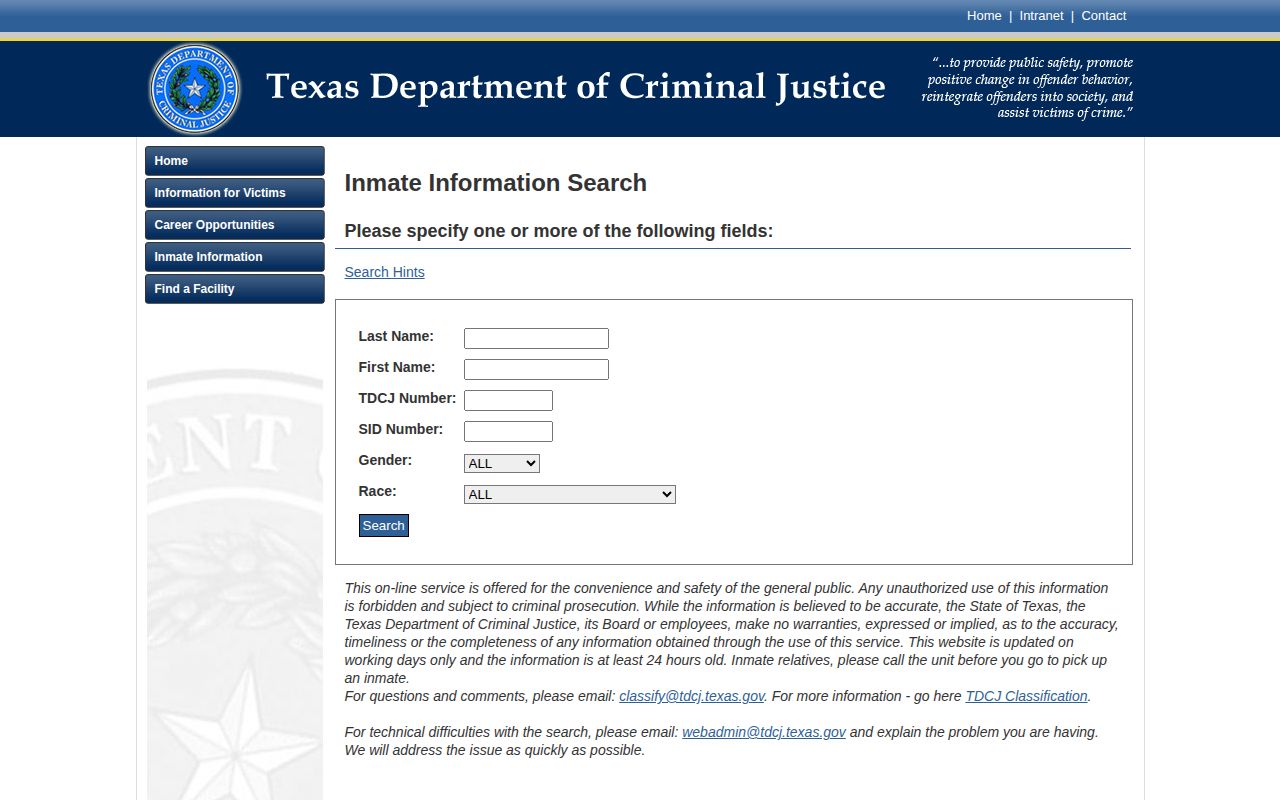
The official TDCJ search screen below shows the correct state source. It should be used only for a person actually held in TDCJ, not as a substitute county-jail calendar.
Texas Credit and Panola Release Dates
Texas Government Code Section 498.003 governs good-conduct time in TDCJ. Good time affects eligibility for parole or mandatory supervision but does not otherwise shorten the sentence term. The law calls it a privilege, not a right. Classification matters. Trusty and Class I status can accrue up to 20 days for each 30 days actually served, Class II can accrue 10, and Class III accrues none. Some program participation may add credit under the statute.
Those figures are not a do-it-yourself release formula. Offense date, eligibility, classification changes, multiple sentences, Board action, and later loss or restoration of credit affect the official computation. Good time does not accrue while a person is on parole or mandatory supervision. Consult the current Government Code chapter 498 and the rules that applied during the actual confinement period.
State-jail felony terms require separate treatment. TDCJ states that state-jail felons generally do not earn ordinary good-conduct time. Certain cases involving offenses committed after September 1, 2011 may receive judge-awarded diligent-participation credit. The TDCJ state-jail credit explanation describes that narrow route. A prison-credit assumption should not be copied into a state-jail calculation.
Texas also has no blanket 85-percent rule in the sources reviewed. Government Code Section 508.145 imposes offense-specific limits, including calendar time equal to one-half the sentence or 30 years, whichever is less, without good-conduct credit for listed offenses and findings tied to Code of Criminal Procedure article 42A.054. It is equally wrong to claim everyone serves 50 percent. The Board's offense-date tables and actual judgment control.
Note: Credit changes eligibility and projections under specific law; the agency computation, not informal subtraction, supplies the operative state date.
Why Panola County Release Dates Move
A projected date can move earlier or later as the record changes. Some factors alter credit or eligibility. Others prevent physical departure even if the sentence calculation remains the same. The key is to ask which field changed: eligibility date, projected date, Board decision, discharge date, or actual release.
| Factor | Possible effect | Record to check |
|---|---|---|
| Credit or classification | Changes eligible good time and recalculates the projection | TDCJ time and classification record |
| Discipline | Can reduce or remove credit and delay eligibility | TDCJ disciplinary and time record |
| Board decision | Approval, denial, or a required program changes the release path | Parole Review Information and Board result |
| Consecutive sentence | One term may have to follow another | Judgments, commitment, and TDCJ calculation |
| Detainer or warrant | Another authority may take or continue custody | Hold, warrant, and receiving-agency intake |
| Court order or correction | Sentence, credit, or authority may change | Signed order and corrected custody record |
| Release processing | Plan, conditions, program, or identity work can delay departure | Release certificate and actual transaction |
A transfer provides the clearest example. Panola may record a departure while TDCJ, another county, BOP, USMS, or ICE begins custody. That is an actual release from Panola's control but not freedom in the community. Always request the destination and receiving agency with the departure time.
Panola County Jail Date Calculation
No Panola-specific jail good-time policy or Sunday or weekend early-release rule was found in the official research. That absence is important. A policy from another Texas county cannot be applied to the Panola County Detention Center, and the TDCJ Projected Release Date field cannot be transplanted to a local sentence.
For a county term, obtain the judgment, sentence length, jail-credit notation, commitment, and custody ledger. Check every active cause. Credit may include time held by another custodian. Concurrent terms run together in a way defined by the judgments, while consecutive terms follow each other. Completion of one cause does not end another hold. Reverse-calculating from a booking date is weaker than the jail's official calculation.
Call the Detention Center at 903-693-0359 for present orientation, then request a written record if the date must be cited. The active jail is at 319 W. Wellington in Carthage. Sheriff administration is at 314 W. Wellington, so callers should ask which location maintains the requested calculation or transaction before traveling. The official pages publish no separate release-record counter schedule.
For a court document, use the cause to select the proper clerk. The Panola District Clerk handles district and felony records and asks for cause number, document or event name, file date, and delivery method. A judgment or release order explains authority. It does not prove the exact time jail staff completed release.
Confirm Panola County Actual Release
Near a projected date, recheck the same official system and note its update time. For TDCJ parole or mandatory supervision, use IVSS and the parole information route, then seek the certificate or custody history. For a Panola jail event, check the jail and bond record, call the jail, and request the actual transaction. For federal or immigration custody, use the system named by the destination record.
A Panola County VINE inmate check can provide a timely release or custody-change alert where a participating source supplies the event. It cannot convert a projection into a certified departure. If an alert arrives, capture its exact wording and time, then verify the date, release type, authority, and destination with the custodian.
When sources conflict, make a timeline of the court authorization, bond posting, county departure, receiving intake, Board vote, certificate, and alert. Date-only fields may hide the sequence. Ask the agency that created the disputed field to explain or correct it. The strongest final proof is the custody transaction paired with the receiving record when custody continued.